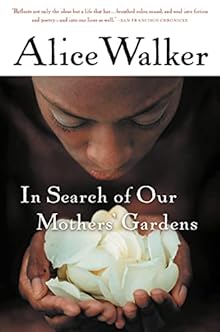
In Search of Our Mother's Gardens, by Alice Walker. I was first introduced to this book in my African-American literature class this past summer. We only read one essay from it (it is a collection of essays written by Walker), but I was hooked and have wanted to read it ever since.
If you have trouble finding it, you can read the first 70ish pages on google books.
I thought that I would introduce two essays, to begin with. Because this book is a collection of essays, you can read them in whatever order you want. You don't even have to read them all! That is the beauty of essay books.
The first essay I read was the title essay, "In Search of Our Mother's Gardens." I loved this essay because it talks about the natural instinct of creating that seems to lie inside of all women, even when they are oppressed or unable to develop their creative arts. I love what she says about her mother when she is working in her garden:
"I notice that it is only when my mother is working in her flowers that she is radiant, almost to the point of being invisible--except as Creator: hand and eye. She is involved in work her soul must have. Ordering the universe in the image of her personal conception of Beauty."
The feminist in me loves that--because, in my personal definition, a feminist is someone who believes in the rights of a woman to be a woman. I don't think women need to be men to have real rights, but when they are not allowed to be themselves--when the have no outlet for creative expression--that is a real tragedy. But somehow, through the centuries, women have kept living and kept loving--and kept creating--even when they lived in circumstances of slavery and oppression. As President Uchtdorf said in October 2008, "The desire to create is one of the deepest yearnings of the human soul. No matter our talents, education, backgrounds, or abilities, we each have an inherent wish to create something that did not exist before." This enduring legacy of creation and beauty is what Alice Walker is searching for when she is searching for her mother's gardens.
The second essay I read was "Looking for Zora." Zora Neale Hurston was one of the first black woman novelists--she wrote Their Eyes Were Watching God and several other novels. Zora was Alice Walker's inspiration, because Alice Walker wanted to be a black woman writer and she wanted a role model, someone who would help her know that she was not alone in this undertaking. I think this essay does a good job of showing just what a role model can mean to someone.
I will leave it at this for now. I am excited to hear what all of you think about the essays--if you have any questions or thoughts, feel free to post them in the comments!

My first disclaimer is that I did not read all the essays. I looked through them and read some but I am sharing the book with Jocilyn because Davis County Library systems only had one copy. Like a dilligent reader I started at the beginning. This may have been a mistake.I felt very conflicted. I moved on to read the two Breanne suggested and found them to be quite thought provoking. It was interesting to see the emotions she had to deal with and as I read on I wondered at her frustration. It was as I read part of an interview with her that I realized that her biggest frustration (besides all the obvious racial things) was her lack of faith and belief in something bigger than this life. Because she had problems with her mother's God and anyone else's she was left to her own and that is not a comfortable place to be. In the essay on the Cotton Gin I was moved when she talked about trying to teach educationally crippled women the significance of their past and the beauty of it when they were taught to regard it with shame. I think we can all learn from our past and become better because of it not in spite of it so I kind of related to this thought. I also liked her thought about how so much of the satisfying work of life begins as an experiment so no experiment is ever a complete failure. I didn't like her thoughts on abortion, suicide, prostitution and lesbians, to name a few. I must be a little short sighted but then I have always said I like to read to escape the problems of real life not to read about them. Just a few thoughts and from how long this is it seems that I am writing an essay.
ReplyDelete