[Sorry--I started this last week but it took me a while to finish it! Have fun finishing this book and reading Anthem.]
Virginia Woolf wrote an essay (quite a long one) called "
A Room of One's Own" in which she discusses the absolute impossibility of success women have faced in writing fiction. She believes that for a woman to be able to write fiction, she needs a room of her own--where she can go to think, to write, and a space that she can own, a place where she can be herself.
I think about her essay often when I read literature written by minorities or those who are oppressed. This past summer I took an African-American literature class, and it really opened my eyes to a lot of the things people struggle with when they are trying to work against public opinion. Those who work to enact change are often viewed as radical, and when we look back with the 20/20 vision of hindsight, sometimes I think we feel that they were perhaps
too over the top. "Be a little more moderate," we might think. "It probably wasn't that bad."
But it
was that bad, and most times when people rise out of the midst of oppression they have to overdo it so that their posterity can have a "normal" live--not too far to the right or to the left.
These are the kind of things I thought about when I took the African-American lit class. I really wanted to choose a book that highlighted the beautiful things I learned about African-American literature, but all of the books that we had read in that class required too much explaining to really understand what they did for the African-American world. So I chose
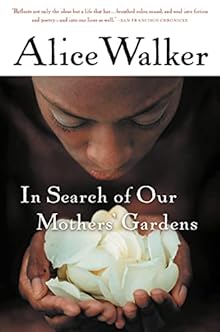
In Search of Our Mothers' Gardens because, as a collection of essays, I thought it would be a perfect way to peek into the mind of an African-American writer. And, if you didn't have time, you could just read a few.
Do I feel uncomfortable when I read this kind of stuff? Of course. I feel uncomfortable that the atrocities that prompted the Civil Rights movement were so recent--just one generation ago. I feel uncomfortable that similar prejudices exist today, even if they are not so prevalent. But I also feel a real sense of empowerment. Just as the African-Americans sand "We shall overcome," they
did overcome, and even though the world isn't perfect yet, it is a lot better.
But there is still a lot of prejudice in the world. This is why I believe it is our duty to become educated about others so we will "understand them better, and love them better" (anyone recognize that quote?). And, I believe that we can learn a lot about our own struggles through life and how to make an impact and a difference, even when everyone else says we can't.
I would love to hear any thoughts any of you had about any of the essays. The following are a few of my favorite quotes:
"So much of the satisfying work of life begins as an experiment; having learned this, no experiment is ever quite a failure." ("But Yet and Still the Cotton Gin Kept On Working")
"Your job...is to change the world. Nothing less or easier than that...the world is not good enought; we must make it better." ("A Talk: Convocation 1972)